





The Coaching Business Is Outgrowing the Notebook
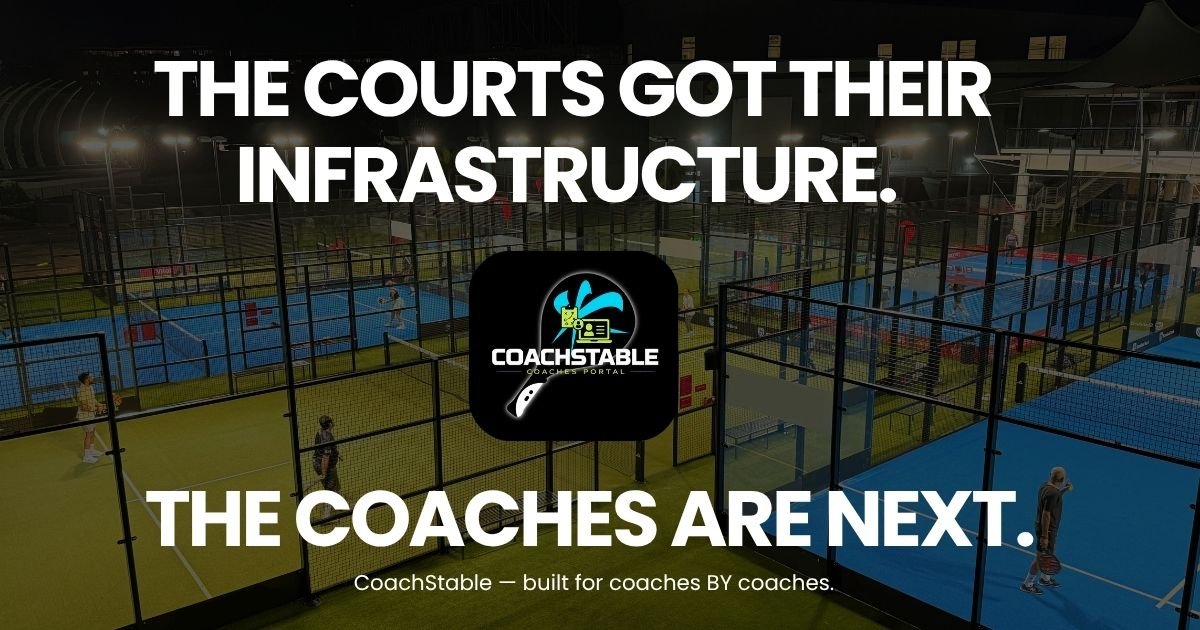
As padel and racket sports scale faster than the systems coaches use to run their businesses, a new layer of infrastructure is starting to emerge — not for the courts this time, but for the coaches.
Padel’s growth has been well documented on this site — new courts, new clubs, new investment cycles chasing the sport’s momentum. Less discussed is what’s happening one level down, at the level of the individual coach.
Every new court that opens creates demand for someone to teach on it. And every coach who takes on that work — padel, tennis, squash, badminton, pickleball, it doesn’t matter which — inherits the same problem almost immediately: the coaching itself was never the hard part. Running the business around it is.
The Administrative Bottleneck Behind Every Coaching Business
Talk to enough independent coaches and a pattern shows up fast. A client’s session time lives in a WhatsApp thread. A rate card gets retyped from memory every time someone new asks. A missed payment gets caught two weeks late, if at all. None of this is a failure of the coach — it’s a failure of the tools. Generic scheduling apps and fitness-industry software were built for gyms and personal trainers, not for the specific rhythms of racket sports: group sessions, court bookings, rate tiers that shift between adults, juniors, and casual play.
The result is a category of business that has scaled in volume — more players, more courts, more demand for coaching — without scaling in structure. Coaches are running real businesses on tools that were never designed for the job.
Built for the Court, Not Adapted to It
This is the gap CoachStable is stepping into. Rather than retrofitting a general fitness or personal-training platform, it’s built specifically around how racket sport coaches actually work: scheduling that understands group sessions, rate structures built for adult, junior, and gameplay categories, attendance tracking, and billing that runs in the background instead of living in a coach’s memory.
It launches with support for four languages — English, Spanish, Swedish, and Arabic — reflecting where competitive and recreational racket sports are actually growing, not just where the software industry defaults to building first.
What Changes When Coaches Have the Right System
- Time returns to the court. Every hour not spent chasing a payment or rebuilding a schedule from a notebook is an hour available for actual coaching — or, just as often, for the coach’s own life outside it.
- Professionalism becomes visible, not just felt. A public rates page and a proper intake form let a coach look as organised as the club they teach at, without needing the club’s back-office support to do it.
- Growth stops being the problem. Flat, unlimited-client pricing means taking on a twentieth client doesn’t cost more than the first — a direct departure from most coaching software, which charges per client and quietly punishes the coaches who succeed.
- Nothing depends on memory. Client history, session notes, and payment status live in one place, regardless of how many clients, courts, or sports a coach is juggling in a given week.
The Next Layer of Padel’s Professional Infrastructure
The court-building phase of padel’s growth is well underway, and it isn’t slowing down. What’s less finished is the layer above it — the systems that let the people actually running lessons on those courts operate like the businesses they’ve become, rather than the side hustles they may have started as.
CoachStable is one entrant into that emerging space, built specifically for racket sports rather than adapted from an adjacent industry. Coaches curious to see it can find it at coachstable.com, with a 14-day trial that doesn’t require a card to start.
The courts got their infrastructure first. It looks like the coaches are next.
Share










Post Comment
You must be logged in to post a comment.